
Anger is a normal human emotion, but when it feels uncontrollable and creates problems in your relationships or work, it may be time for a new approach. For those exploring their options in Newport Beach, CA, Cognitive Behavioral Therapy (CBT) for anger management is a practical, evidence-based method for regaining control. This guide explains how it works and what to expect.
This content is informational and not medical advice.
Table of Contents
- How CBT Helps You Understand and Control Anger
- Core Techniques for Managing Anger with CBT
- Does CBT Anger Management Actually Work?
- Integrating CBT for Anger in Dual Diagnosis Treatment
- Practical Examples of Managing Anger
- Finding CBT Anger Management in Newport Beach
- Frequently Asked Questions
How CBT Actually Helps You Understand and Control Anger
Imagine your thoughts, feelings, and actions are connected. A single thought—for example, assuming a friend canceling plans means they don't value you—can trigger angry feelings, which can lead to a reactive behavior, like sending a hostile text.
CBT for anger management teaches you how to intervene before that chain reaction starts. It provides tools to examine the initial thought and assess it objectively.
This isn't about suppressing anger. It's about learning to identify the automatic thought patterns that escalate it. You learn to pause, identify the true trigger, and challenge the initial "hot" thought before it spirals into an outburst you might regret.
The Core Principle Behind CBT
CBT is based on a powerful idea: it’s not the event itself that makes you angry, but your interpretation of it.
For instance, two people get cut off in traffic on the Pacific Coast Highway. The first person’s immediate thought is, "They have no respect!" and their anger spikes. The second person thinks, "They must be in a major hurry," and feels a flash of annoyance that quickly passes. It's the same event, but two different interpretations lead to vastly different emotional responses.
CBT helps you become more like the second person by training you to notice your personal anger triggers and the "cognitive distortions"—faulty thinking habits—that amplify your emotional reaction.
Building Practical Skills
Working with a therapist using CBT involves actively building a practical skillset for managing your reactions. This typically includes:
- Identifying Triggers: Pinpointing the specific situations, people, or internal states (like hunger or fatigue) that reliably lead to an angry response.
- Cognitive Restructuring: Learning to catch automatic negative thoughts, evaluate them for accuracy, and reframe them into more balanced and realistic alternatives.
- Developing Coping Strategies: Building a toolkit of healthy responses, from simple breathing exercises and relaxation techniques to knowing when to take a strategic time-out.
- Improving Communication: Learning to express your needs and feelings assertively—not aggressively or passively—to communicate effectively without damaging relationships.
CBT provides a clear roadmap to understanding the drivers of your anger. For individuals in Newport Beach, especially those also navigating substance use recovery where emotional regulation is key, these skills are fundamental. By changing how you think, you can change how you feel and, most importantly, how you act.
Core Techniques for Managing Anger with CBT
Cognitive Behavioral Therapy offers a practical toolkit to understand what triggers your anger and how to change your reactions. Instead of being controlled by a short temper, these techniques provide a structured way to pause and break the cycle where a frustrating thought sparks intense anger and leads to regrettable actions.
The infographic below illustrates this cycle, showing how our thoughts, feelings, and behaviors are interconnected.
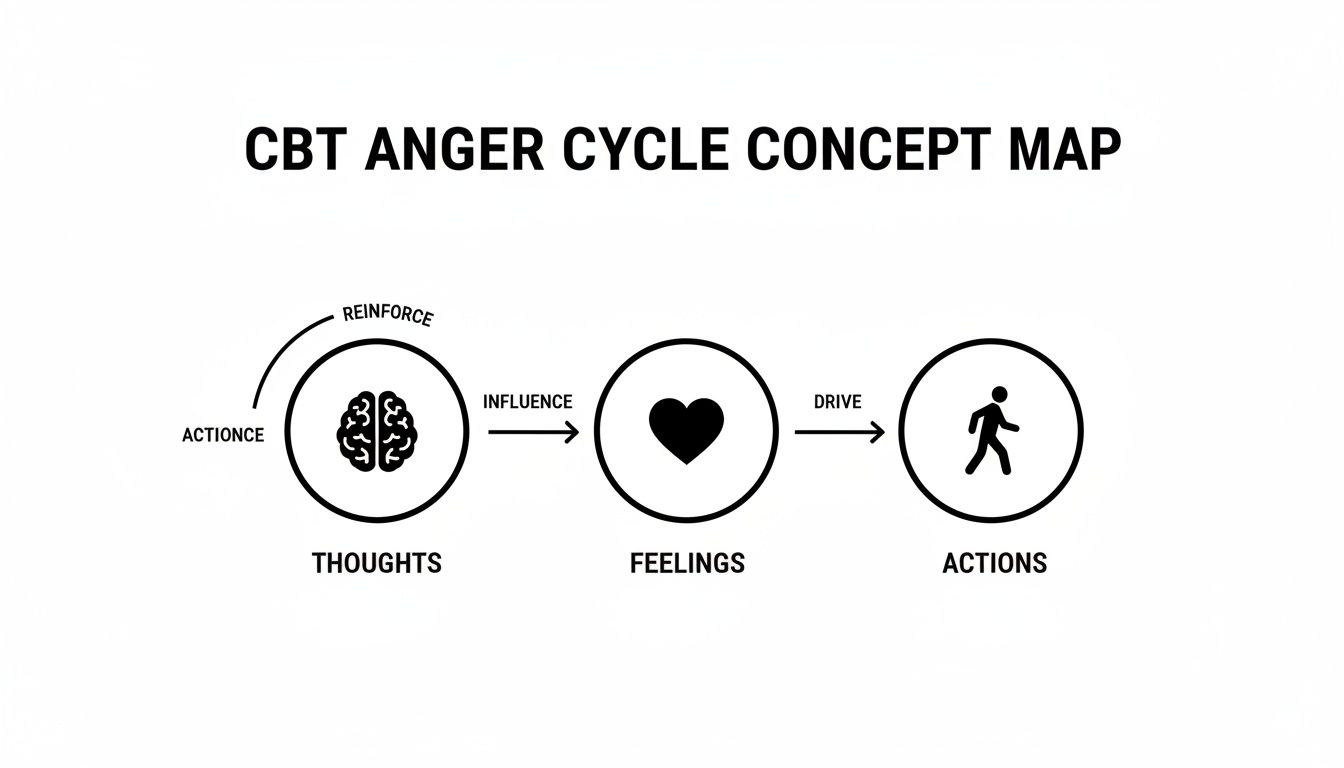
As you can see, the cycle often starts with a thought. That thought influences how you feel, which in turn drives what you do. Your actions then reinforce the original thought, locking you into a loop. CBT helps you break that chain at its weakest link: the initial thought.
Cognitive Restructuring: Changing Your Thought Patterns
At the heart of CBT anger management is a process called cognitive restructuring. It is the practice of identifying, questioning, and rewriting the automatic, unhelpful thoughts that fuel anger. Many of these thoughts are rooted in cognitive distortions—common thinking traps that distort reality.
For example, a common distortion is "personalization," where you automatically assume you're to blame for something negative. If a colleague is short with you, the automatic thought might be, "What did I do? They must be mad at me."
Cognitive restructuring trains you to pause and challenge that assumption. You learn to ask, "Is there another way to look at this? Maybe they’re stressed about a deadline or had a difficult morning." This small shift can defuse your anger before it escalates.
You essentially become a detective of your own thoughts by:
- Identifying the Trigger Thought: What specific thought set you off?
- Examining the Evidence: What are the facts for and against this thought?
- Considering Alternatives: What are two or three other possible explanations?
- Creating a Balanced Thought: Formulate a new, more realistic thought based on the evidence.
Practicing this consistently helps form new neural pathways, making it more natural to respond thoughtfully instead of reacting emotionally.
Thought Records: Identifying Your Anger Patterns
You cannot change what you are not aware of. A thought record is a simple but effective tool for becoming an expert on your own anger. It functions like a journal designed to connect the dots between events and your emotional responses.
A typical thought record prompts you to note:
- The Situation: Where were you and what was happening?
- Automatic Thoughts: What was the first thing that went through your mind?
- Your Feelings: What emotion did you experience, and how strong was it on a scale of 1-10?
- Your Behavior: What did you do or say?
- The Outcome: What happened as a result?
Keeping a thought record for even a week or two can be an eye-opening experience. It clearly lays out your triggers and thinking patterns, giving you and your therapist a precise map for where to focus your efforts.
Core CBT Anger Management Techniques at a Glance
This table summarizes the main tools CBT provides. Each plays a distinct role in helping you regain control over your reactions.
| CBT Technique | Core Purpose | Simple Example Application |
|---|---|---|
| Cognitive Restructuring | To identify and challenge irrational thoughts that fuel anger. | Asking, "What's a more balanced way to see this?" when you feel unfairly criticized. |
| Thought Records | To track and identify the patterns between triggers, thoughts, and anger. | Jotting down what happened after a frustrating phone call to see the thought-feeling link. |
| Behavioral Experiments | To test the validity of your angry assumptions through real-world actions. | If you assume asking for help shows weakness, you might test that by asking a coworker for help. |
| Relaxation Techniques | To calm the body's physiological "fight or flight" response to stress. | Using the 4-7-8 breathing method when you feel your heart start to race in traffic. |
| Problem-Solving Skills | To address frustrating situations constructively instead of just getting angry. | Breaking down a large, overwhelming project into small, manageable action steps. |
These techniques work together, giving you a multi-layered approach to managing uncontrolled anger by addressing both the mental and physical aspects.
Behavioral Strategies: Taking Action in the Moment
While challenging your thoughts is crucial, CBT also provides practical, in-the-moment actions to manage anger. These behavioral strategies help calm your body and navigate difficult situations more effectively.
Think of these as an emotional first-aid kit. When you feel the familiar rise of anger, you have go-to tools ready to de-escalate the situation.
Here are a few common behavioral tools:
- Relaxation Techniques: This is about calming your physical response. Simple exercises like deep diaphragmatic breathing (try the 4-7-8 method: inhale for 4 seconds, hold for 7, exhale for 8) or progressive muscle relaxation can signal your nervous system to calm down. Practicing them when you're calm makes them easier to use when you're stressed.
- Problem-Solving Skills: Anger often arises when we feel powerless. CBT teaches a step-by-step method for tackling problems by breaking overwhelming issues into small, actionable pieces. This shifts your mindset from helpless frustration to proactive control.
- Assertive Communication: There is a significant difference between being assertive and being aggressive. Assertiveness is about expressing your needs and feelings clearly and respectfully. A core skill is using "I" statements (e.g., "I feel frustrated when…") instead of accusatory "You" statements ("You always make me…").
By combining these behavioral skills with cognitive restructuring, you build a robust system for CBT anger management that addresses your mind, body, and actions.
Does This Stuff Actually Work? A Look at CBT's Proven Track Record
When considering therapy for anger, a common question is: "Does this really work?" For Cognitive Behavioral Therapy (CBT), the answer is supported by extensive evidence.
CBT is a hands-on, skills-based approach that has a strong track record for creating real, sustainable change. It provides practical tools to rewire the thought patterns that fuel angry outbursts. The skills you learn are not temporary fixes; they are strategies you can use for the rest of your life.
Why CBT Leads to Lasting Change
CBT empowers you by teaching you to identify the specific thought patterns and triggers that set you off. This awareness shifts you from being reactive to being proactive.
This allows you to disrupt the anger cycle before it spirals. As you gain control over major outbursts, the constant, low-grade stress and irritability that often accompany anger may also begin to fade. This creates a positive feedback loop: emotional calm helps you think more clearly, and clearer thinking helps you stay calm.
You don't learn to suppress anger. You learn to change your relationship with it. CBT helps you develop a new script for your inner monologue, enabling you to respond to life with intention instead of instinct.
The Hard Evidence Behind CBT
The effectiveness of CBT is backed by significant research. Studies have shown just how effective these techniques are in real-world applications.
One major analysis of CBT-based anger management programs found they substantially reduced the likelihood of re-offending in high-risk populations. The study showed that these programs lowered the overall risk of general recidivism by 23%. The risk of violent recidivism dropped by 28%.
For participants who completed the full program, the results were even more pronounced. Their risk for general recidivism fell by 42%, and for violent recidivism, it dropped by 56%. You can read more about the research on CBT's success rates here.
These numbers demonstrate that CBT works because it addresses the root of the problem: the thoughts and beliefs that drive our actions.
Building Skills That Last a Lifetime
Ultimately, the goal of CBT anger management is to equip you to become your own therapist. The tools you learn—from challenging distorted thoughts to problem-solving and relaxation exercises—become a permanent part of your mental toolkit.
The next time you’re stuck in traffic, dealing with a difficult coworker, or navigating family conflict, you’ll have a reliable plan. This self-reliance is what makes CBT so powerful for long-term change, offering a clear and sustainable path to a calmer, more controlled life.
Integrating CBT for Anger in Dual Diagnosis Treatment
For many people, anger and substance use are interconnected, creating a cycle that can feel difficult to escape. Uncontrolled anger often becomes a trigger, leading a person to use drugs or alcohol to cope with overwhelming feelings.
Conversely, substance use can lower inhibitions and impair judgment, leading to more frequent and intense outbursts of anger. This is a feedback loop where each problem exacerbates the other. Treating only one issue often allows the other to undermine progress.
This is why treatment for co-occurring disorders, often called dual diagnosis, is essential. In reputable treatment programs across Newport Beach and Costa Mesa, CBT anger management is not just an add-on; it is a core component of the recovery process.
The Role of CBT in Breaking the Cycle
A comprehensive dual diagnosis approach treats substance use and mental health issues simultaneously. CBT is well-suited for this challenge because it provides practical skills that address the link between anger and substance use.
Instead of simply advising someone not to drink when angry, CBT teaches them how to manage the anger itself. By learning to identify and reframe the thoughts that fuel anger, you can reduce the emotional intensity that drives you to use. This provides healthier ways to handle life's frustrations.
By integrating CBT for anger into treatment, dual diagnosis programs help build a stronger foundation for sobriety. Learning to manage emotional triggers is just as important as managing cravings. The goal is to replace the automatic reaction—"I'm angry, I need a drink"—with a conscious, constructive response: "I feel angry. Let's pause. What's the thought behind this feeling? What's a healthy way I can respond right now?"
Why Integrated Treatment Is More Effective
Treating anger and addiction separately is often ineffective. An integrated approach ensures the skills you learn in CBT anger management directly support your recovery goals.
Here’s what integration looks like in a treatment setting:
- Identifying Shared Triggers: In therapy, you will pinpoint the specific situations, people, or thoughts that trigger both your anger and your cravings. This creates a clear map of your personal high-risk scenarios.
- Building a Unified Skillset: You'll learn how CBT tools like thought records and relaxation techniques can be used to defuse both an angry impulse and an urge to use.
- Improving Emotional Regulation: By learning to tolerate uncomfortable emotions like frustration or disappointment without resorting to substances, you build genuine resilience against relapse.
This unified strategy creates a more durable path to recovery. Research supports this, showing how effective CBT is at reducing the impact of daily stressors. A 2019 study found that a 12-week CBT program for anger resulted in an 18.88% reduction in negative feelings during stressful moments. By lowering emotional reactivity, CBT helps reduce the daily triggers that can lead to substance use. You can explore the full study on how CBT blunts emotional spikes from daily hassles.
Finding Dual Diagnosis Care in Orange County
Many people with substance use disorders also face challenges with impulse control, which is often tied to anger. For example, stimulant use can increase irritability, making anger management skills an essential part of recovery. Our guide on managing Adderall withdrawal symptoms offers more context on this connection.
For anyone in Newport Beach, Irvine, or Huntington Beach, finding a program that specializes in dual diagnosis is key. Look for centers that explicitly state they integrate CBT anger management into their addiction treatment. This ensures you receive the comprehensive care needed to address both issues effectively.
Practical Examples of Managing Anger
Understanding the theory behind CBT is one thing, but applying it is where change happens. Here are some real-world examples of how CBT anger management works and how you can determine your next steps in the Newport Beach area.
Decision Frameworks: When to Seek Help
Knowing what level of care you need can be confusing, particularly when anger is linked to substance use. Here is a simple framework to guide your decision.
If you are having violent outbursts, thinking of harming yourself or others, or using substances daily to cope: You may need intensive support, such as a residential or inpatient treatment program. This provides a 24/7 safe, structured environment.
If anger is creating serious problems at work or home, but you have a stable living situation and do not need medical detox: A Partial Hospitalization Program (PHP) or Intensive Outpatient Program (IOP) in Newport Beach could be a good fit. These programs offer hours of therapy several days a week while you live at home.
If you have some coping skills but need ongoing support to manage triggers: Weekly outpatient therapy with a CBT specialist can provide consistent guidance. This is also an excellent "step-down" option after completing a more intensive program.
Example Scenario: Using the STOP Skill
Consider a common scenario: you're stuck in traffic on the 405, trying to get to a meeting in Irvine, and another driver cuts you off.
Your automatic thought is: "That person did that on purpose to disrespect me. Now I'm going to be late, and it's their fault."
You feel your heart pound and your grip tighten on the steering wheel. You have an urge to honk and tailgate.
This is a choice point. Instead of reacting impulsively, you can use the STOP skill:
- S – Stop: For one second, pause. Do not do anything. Fight the urge to react.
- T – Take a Breath: Take one slow, deep breath. Inhale for four seconds, hold for seven, and exhale for eight. This helps calm your body's fight-or-flight response.
- O – Observe: Notice what is happening without judgment. "My heart is racing. My shoulders are tense. I'm thinking about being disrespected." Observe the reality: "Traffic is heavy. Maybe they're in an emergency. I don't know their situation."
- P – Proceed Mindfully: Now that the initial emotional intensity has decreased, you can choose what to do. You decide to slow down, put on some music, and accept that being a few minutes late is manageable. You have just prevented a minor annoyance from escalating.
Questions to Ask a Treatment Provider
When you call treatment centers in Newport Beach or Costa Mesa, being prepared with questions can help you find a program that fits your needs, especially for dual diagnosis.
Here are some questions to ask:
- “Do you provide dual diagnosis treatment for anger and substance use?”
- “Is CBT anger management a core part of your program?”
- “What does a typical day look like in your PHP or IOP?”
- “How is family involved in the treatment process?”
- “What insurance plans do you accept?”
- “What aftercare support is offered to help maintain progress?”
Asking these questions empowers you to make an informed decision. To get started, you can explore levels of care in the Newport Beach area.
Finding CBT Anger Management in Newport Beach

Once you decide to seek professional help, knowing where to turn locally is the first step. The calming, coastal environment of Newport Beach and its surrounding communities like Costa Mesa and Huntington Beach can provide a supportive backdrop for this work.
It is important to find a program designed to meet your specific needs. There are different "levels of care" structured to provide the right amount of support.
Levels of Care in Orange County
You can find a full spectrum of care options throughout the Newport Beach area. The best fit depends on your unique situation.
Residential Treatment: This is the highest level of support, offering 24/7 care in a live-in facility. It is a suitable choice if your anger has become severe, is intertwined with substance use, or if you need a safe environment away from daily triggers.
Partial Hospitalization Program (PHP): A step down from residential, PHP provides a full day of structured therapy—typically 5-6 hours a day, 5 days a week—while you return home or to a sober living residence at night.
Intensive Outpatient Program (IOP): IOP offers the most flexibility, with therapy for a few hours a day, several times a week. This allows you to maintain work, school, or family commitments. It is a good option for those who are stable, stepping down from a higher level of care, or need more support than a standard weekly therapy session.
Who Is Each Level Best For?
Choosing the right level depends on the intensity of your symptoms and your daily life. The goal is to provide the least restrictive level of care that is clinically effective, empowering you to practice new skills in your real-world environment.
- Choose residential care if anger is leading to dangerous situations or if you have a co-occurring substance use disorder that requires medical oversight.
- Choose PHP if you can manage evenings and weekends independently but need the structure of a daily therapeutic program.
- Choose IOP if you have a strong support system and need to fit treatment around your life in areas like Irvine or Laguna Beach.
No matter where you start, the key is finding a program that specializes in CBT anger management. You can compare local programs to see which options align with your needs.
Frequently Asked Questions About CBT Anger Management
Here are straightforward answers to common questions about CBT anger management, particularly for individuals in the Newport Beach area.
How Long Does CBT for Anger Usually Take?
There is no fixed timeline, as it depends on your specific situation and whether you are also addressing a co-occurring condition like a substance use disorder. However, CBT is designed to be a short-term, skills-based therapy. Many people begin to see significant progress within 12 to 20 sessions. In a structured program like an IOP or PHP, this progress can occur over a few weeks or months. The goal is to provide you with a toolkit you can use independently.
Will CBT Get Rid of My Anger Completely?
No, and that is a positive outcome. Anger is a normal, healthy emotion that can signal when a boundary has been crossed or something is wrong. The goal of CBT is not to eliminate anger but to help you manage your response to it. You learn to reduce the intensity of your anger so it no longer controls your actions, allowing you to respond to frustrating situations thoughtfully instead of reactively.
Can CBT Help If My Anger Is Related to Trauma?
Yes, but it is important to work with a therapist trained in trauma-informed care. Anger is a common response to trauma. A therapist may use a specific approach like Trauma-Focused Cognitive Behavioral Therapy (TF-CBT), which combines standard CBT tools with techniques sensitive to trauma. This creates a safe environment to process the event and learn to manage the intense emotions associated with it.
What Is the Difference Between Anger and Aggression?
This is a critical distinction. Anger is the internal feeling. Aggression is the external behavior—yelling, hitting a wall, or making hurtful comments. Aggression is an action intended to cause harm. You can feel angry without acting aggressively. CBT anger management teaches you to create a pause between the feeling (anger) and the action (aggression), allowing you to choose a constructive response.
Is CBT for Anger Management Covered by Insurance?
In most cases, yes. Cognitive Behavioral Therapy is an evidence-based treatment and a standard approach for many mental health conditions, including issues related to anger. Most insurance plans cover CBT under their mental health benefits when provided by a licensed therapist or treatment center. It is always best to check your specific plan's benefits. Our directory of recovery resources can help you navigate these practical details.
Newport Beach Rehab provides clear, reliable information to help you find the right path forward. If you are ready to explore your options and learn how your insurance can help, you can compare programs and confidentially verify your coverage.