
This content is informational and not medical advice.
When you have a family member with an alcohol problem, life can feel isolating, painful, and overwhelmingly confusing. It’s important to know you are not alone. The first step toward healing for everyone involved is understanding that Alcohol Use Disorder (AUD) is a recognized medical condition—a disease of the brain, not a personal failure. This guide offers practical support for families in Newport Beach, CA, and surrounding communities, helping you find a clear path forward.
Table of Contents
- What Is Alcohol Use Disorder?
- Recognizing the Signs of Alcohol Use Disorder
- Finding the Right Treatment Path in Newport Beach
- Practical Examples
- Prioritizing Your Own Well-Being and Support
- Common Questions When a Loved One Struggles with Alcoholism
What Is Alcohol Use Disorder?

Alcohol Use Disorder, sometimes referred to as alcoholism, is a medical condition where a person cannot stop or control their drinking, even when it causes serious problems with work, family, or health. It is not a lack of willpower; it is a chronic brain disorder.
Over time, heavy drinking can change brain chemistry. It alters the circuits that manage rewards, stress, and self-control, making it incredibly difficult for someone to simply quit on their own. The brain chemistry shifts to a point where it depends on alcohol to function.
It's a Medical Condition, Not a Moral Failure
For families, viewing AUD as a disease can be a turning point. It allows you to move away from blame and judgment and toward compassion and support. You would not blame a relative for having heart disease, and AUD requires a similar level of care with professional medical and psychological treatment.
This shift in perspective is the foundation for having productive conversations and taking effective action. When your loved one feels understood instead of attacked, the door to seeking help is more likely to open.
The Widespread Impact on Families
The ripple effects of an alcohol use disorder touch everyone in the family. According to the National Institute on Alcohol Abuse and Alcoholism (NIAAA), over 10% of U.S. children live with a parent with alcohol problems. You can review more alcohol abuse statistics.
Living with a person who has AUD often means navigating an environment filled with tension and unpredictability. It’s common for family members to experience a mix of difficult emotions:
- Anxiety and Fear: Constantly worrying about your loved one’s health, behavior, and safety.
- Frustration and Anger: Feeling helpless over broken promises or resentful about the chaos they cause.
- Guilt and Self-Blame: Wondering if you did something to cause their drinking (you did not).
- Embarrassment and Isolation: Hiding the reality from friends and other relatives out of shame.
These feelings are valid. Acknowledging the emotional toll on the entire family is a crucial part of the healing process. For those in Newport Beach and nearby communities like Costa Mesa and Irvine, local support systems and professional treatment centers are ready to help both your loved one and your family.
Disclaimer: This content is for informational purposes only and is not a substitute for professional medical advice. If you or a loved one is struggling, please consult a qualified healthcare provider.
Recognizing the Signs of Alcohol Use Disorder

When you live with an alcoholic in the family, spotting the signs of Alcohol Use Disorder (AUD) can be challenging. The changes often happen so slowly that you may start to question your own judgment.
The point isn't for you to make a clinical diagnosis. It's about recognizing patterns of behavior that show their relationship with alcohol has become harmful. These patterns usually fall into behavioral, physical, and emotional categories.
Common Signs of an Alcoholic in the Family
Trying to piece everything together can be overwhelming. To help clarify what you might be seeing, the common signs of AUD are broken down below. This can help you see if isolated incidents are part of a larger, more concerning pattern.
| Category | Observable Signs |
|---|---|
| Behavioral | Hiding alcohol or drinking in secret. Neglecting work, school, or family duties. Losing interest in hobbies. Getting into arguments or legal trouble related to drinking. |
| Physical | Needing more alcohol to get the same effect (tolerance). Experiencing shakes, nausea, or sweating when not drinking (withdrawal). Red or puffy face, unexplained weight changes, poor hygiene. Complaining of poor sleep or constant fatigue. |
| Emotional | Extreme mood swings, irritability, or defensive anger, especially about drinking. Signs of anxiety or depression. Blaming others or situations for their problems (denial). |
Seeing a combination of these signs from different categories is often a strong indicator that professional help is needed.
Behavioral and Social Changes
One of the first things family members often notice is a slow but steady shift in their loved one's priorities and social circles. Alcohol begins to take up more space, crowding out people and responsibilities.
- Increased Secrecy and Deception: You might find hidden bottles in the garage or closet. They may drink alone more often or lie about how much they’ve had.
- Neglecting Responsibilities: This is a pattern of missed deadlines at work, unpaid bills, or consistently letting down the family.
- Loss of Interest: Hobbies they once enjoyed now sit untouched. Social events are either skipped or become centered entirely around the opportunity to drink.
- Relationship Problems: You might find yourself walking on eggshells. Arguments become more frequent, often sparked by their drinking or the chaos it creates.
These are red flags showing that alcohol is no longer just in their life—it's starting to run it.
Physical and Health Indicators
Over time, the physical damage from heavy drinking becomes harder to hide. Some signs are subtle, but others are clear warnings that their health is in jeopardy.
Look for these common physical indicators:
- Changes in Appearance: This can include persistent facial redness or puffiness, significant weight gain or loss, and a decline in personal grooming.
- Tolerance and Withdrawal: You may notice they need more alcohol to feel "normal." If they try to stop, you might see them get shaky hands, start sweating, or feel nauseous—these are classic signs of withdrawal.
- Frequent Sickness: Chronic drinking can weaken the immune system, so they may get sick more often. They might also complain about stomach pain or, in advanced cases, show signs of liver damage like jaundice (a yellowing of the skin and eyes).
- Sleep Disturbances: Alcohol disrupts restorative sleep. They may complain about insomnia or seem exhausted all the time, no matter how long they were in bed.
Emotional and Psychological Warning Signs
Alcohol is a depressant that alters brain chemistry, so it can have a significant impact on a person's emotional stability. For families, this can make the home environment feel unpredictable.
- Mood Swings and Irritability: They might become angry for no apparent reason or get defensive if you bring up their drinking.
- Anxiety and Depression: It can be a vicious cycle. Some people drink to self-medicate underlying anxiety or depression, but alcohol ultimately makes both conditions worse.
- Denial: This is a powerful psychological roadblock. It’s an inability to connect their drinking to the problems it's causing. It's always someone or something else's fault.
If these patterns feel familiar, it’s a sign that things have gone beyond social drinking. This is the point where exploring professional support and treatment options available in Newport Beach and Orange County becomes a logical next step.
When a person in a family has an alcohol use disorder, no one is left untouched. The home, once a place of safety, can start to feel unpredictable.
Unspoken Roles in a Family with an Alcoholic
To survive the instability, family members often fall into specific roles without realizing it. These are coping mechanisms developed to get through the day. Spotting these roles in your own family is a powerful first step toward breaking the cycle.
- The Enabler: Often a spouse or parent who, out of love or a need for peace, shields the person from the consequences of their drinking. They might call in sick for them or cover up their behavior.
- The Hero: Usually an older child, the hero becomes a perfectionist. They get good grades and excel in activities to prove the family is okay. This path is often filled with anxiety.
- The Scapegoat: This is the "problem child." Their acting out becomes a distraction from the larger issue. It’s easier for the family to focus on the scapegoat’s behavior than to face the alcohol problem.
- The Lost Child: This person’s strategy is to disappear. They are quiet, keep to themselves, and avoid conflict. This can lead to loneliness and difficulty connecting with others later.
While these roles help a family function on the surface, they create an unhealthy balance that can prevent healing.
The Financial and Emotional Cost
The burden is more than just emotional. The financial strain can be significant, adding another layer of stress. Nationally, alcohol misuse costs the U.S. economy billions each year. Learn more about the national cost of alcohol misuse.
For a family, this can look like drained savings, debt from legal troubles, and the cost of medical care. That financial pressure, piled on top of the daily emotional exhaustion, can feel isolating. Bringing these patterns to light isn't about pointing fingers. It's about seeing the situation for what it is: a family disease that needs a family-wide solution.
Finding the Right Treatment Path in Newport Beach
Navigating addiction treatment can feel overwhelming. The good news is that there is a structured path forward, with different levels of care designed to meet your loved one where they are. In Newport Beach and the surrounding areas like Huntington Beach and Laguna Beach, a full spectrum of options is available.
Understanding these options is the first step toward making an informed decision. Each level serves a unique purpose, from safely managing withdrawal to providing flexible support. The right choice depends on your family member's medical needs, the severity of their drinking, and their living situation.
Medical Detox: The First Step for Safety
For anyone with a significant physical dependence on alcohol, stopping "cold turkey" can be dangerous. This is where medical detox is a critical first step. It’s a medically supervised process where healthcare professionals help manage the intense and sometimes painful symptoms of alcohol withdrawal.
Withdrawal can trigger serious health problems, including seizures, high blood pressure, and tremors. Detox provides a safe, controlled environment with 24/7 medical monitoring. It's important to know that detox isn't therapy; its purpose is to stabilize the body so the work of recovery can begin.
The roles we fall into as a family can also influence treatment decisions. This flowchart shows some of the common patterns that emerge.
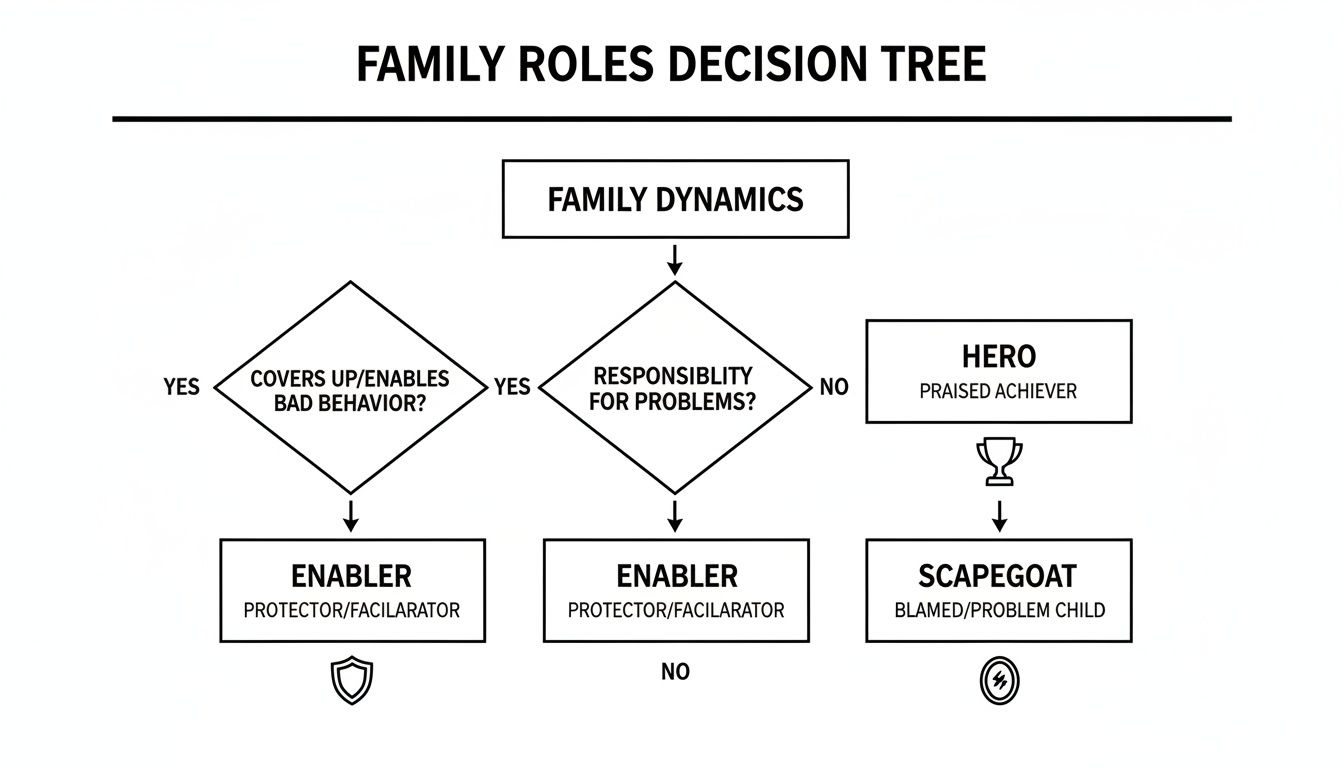
Whether you see yourself as the overachieving Hero or the protective Enabler, recognizing these dynamics is a huge step toward understanding if the family is ready for change.
Residential Treatment: An Immersive Healing Environment
Once detox is complete, or for those who don't need it, Residential Treatment (often called inpatient rehab) offers an immersive therapeutic setting. In this program, your loved one lives at the facility, which removes them from the people, places, and stressors that trigger their drinking.
This structured environment allows them to focus entirely on getting well. A typical day in a Newport Beach residential program includes:
- Individual Therapy: One-on-one sessions to explore the root causes of the addiction.
- Group Counseling: Sharing experiences and building a supportive community with peers.
- Family Therapy: Guided sessions to heal family dynamics and improve communication.
- Holistic Activities: Many local programs incorporate activities like yoga, meditation, or outdoor time to support wellness, taking advantage of the quiet coastal environment.
Residential care is often the best choice for people with severe AUD, co-occurring mental health conditions (dual diagnosis), or an unstable home life.
PHP and IOP: Flexible Yet Structured Support
Not everyone needs to be in a facility 24/7. For people stepping down from residential care or those with a supportive home life, Partial Hospitalization Programs (PHP) and Intensive Outpatient Programs (IOP) provide strong support with more independence.
- Partial Hospitalization (PHP): This is the most intense non-residential program, often involving treatment for 5-6 hours a day, five days a week. The person returns home or to a sober living house in the evenings.
- Intensive Outpatient (IOP): An IOP is a step down from PHP, typically requiring 3-4 hours of treatment for 3-5 days per week. This is a good fit for people who need to continue with work, school, or family responsibilities.
Exploring these different levels of treatment care is key to finding a program that aligns with your loved one's needs.
Practical Examples
When you're dealing with an alcoholic in the family, theory only gets you so far. It’s important to know what to do right now. Here are realistic scenarios and decision-making guides to help you move from uncertainty to clarity. The goal is to provide a concrete plan of action.
Decision Frameworks: Choosing a Level of Care
- If someone is shaking, sweating, or nauseous after stopping alcohol: They may need medical detox. An outpatient program is likely not a safe starting point due to the risk of severe withdrawal symptoms.
- If someone can’t stop drinking despite consequences but is medically stable: Residential or inpatient rehab may be appropriate. This provides a structured environment away from daily triggers.
- If someone has work or family obligations and no severe withdrawal symptoms: An Intensive Outpatient Program (IOP) in Newport Beach may provide structured care without requiring them to live at a facility.
Scripts: What to Say to Your Loved One
Starting a conversation is often the hardest part. Lead with concern and use "I" statements to avoid sounding accusatory.
- Gentle Opener: "I love you and I'm worried about you. I've noticed [mention a specific, recent behavior, like 'you've been missing work'] and it makes me feel scared. I want to be here for you, and I've started looking into ways we could get some support."
- Setting a Boundary: "I cannot have this conversation with you when you've been drinking. We can talk about this tomorrow when you are sober."
Be prepared for a defensive reaction. Stay calm and bring the conversation back to your love and concern for their well-being.
Checklist: Questions to Ask a Treatment Center
When you call a rehab facility, you are interviewing them. Be prepared with a list of questions.
About the Program:
- “Do you provide medical detox onsite or refer out?”
- “What does a typical week of programming look like?”
- “Is dual diagnosis treatment available for co-occurring mental health conditions?”
About Logistics:
- “What insurance plans do you accept?”
- “What are the estimated out-of-pocket costs?”
- “What is the average length of stay for someone with a similar history?”
About Family & Aftercare:
- “Do you offer family therapy or other support for family members?”
- “What kind of aftercare planning and support is offered?”
Getting clear answers will empower you to compare options and make a confident choice. You can contact our admissions support team for confidential, no-pressure guidance.
Prioritizing Your Own Well-Being and Support

Loving someone through addiction is an emotionally and physically draining journey. In the chaos of trying to help, it’s easy to lose yourself. Putting your own well-being first isn’t selfish—it’s necessary for your survival and for your loved one’s long-term recovery.
You cannot pour from an empty cup. If you become depleted, you won’t have the strength to support anyone. This is why learning to set and enforce healthy boundaries is one of the most powerful and loving things you can do.
Setting Healthy Boundaries
Boundaries are not about punishing or controlling your loved one. They are the rules you establish to protect your own mental, emotional, and physical health. They define what you are and are not willing to tolerate.
By setting clear boundaries, you take back control of your own well-being. This can also help the person with AUD face the natural consequences of their drinking, which can be a catalyst for change.
Here are a few examples of healthy boundaries:
- Financial Boundaries: “I love you, but I will no longer give you money or pay your bills.”
- Emotional Boundaries: “I can’t have a conversation with you when you’ve been drinking. We can talk when you’re sober.”
- Physical Boundaries: “For my own peace of mind, you can’t be in my home when you’re intoxicated.”
The hardest part is enforcing the boundaries you set. Expect pushback, but holding firm is an act of self-respect and is crucial for breaking dysfunctional cycles.
Finding Support for Yourself
You do not have to go through this alone. There are support systems designed specifically for families affected by a loved one’s addiction.
- Al-Anon Family Groups: This is a fellowship of relatives and friends of individuals with alcoholism. It provides a safe space to share your story and learn coping strategies from people who understand. You can find meetings throughout Orange County.
- Family Therapy: Working with a therapist who specializes in addiction can help the entire family system heal. It provides tools to improve communication, rebuild trust, and dismantle unhealthy roles.
- Self-Care: It is important to build small, restorative practices into your daily life. This could be a quiet walk along the beach, taking 15 minutes to read, or connecting with supportive friends.
You can learn about local recovery resources and support groups to find the right fit for your family.
Common Questions When a Loved One Struggles with Alcoholism
When an alcoholic is in the family, your mind can be flooded with questions. Below are straightforward answers to common concerns.
Am I Helping or Enabling Them?
It's a fine line. The difference comes down to the outcome of your actions.
Helping supports their long-term recovery. This includes encouraging them to see a doctor, offering to drive them to a support meeting, or joining them in family therapy. These actions promote health and accountability.
Enabling, however, shields them from the consequences of their drinking. This might look like making excuses for them, giving them money you suspect will go toward alcohol, or cleaning up after them. While it often comes from a place of love, enabling allows the addiction to continue.
How Can I Talk to Them When They're in Denial?
This is one of the toughest conversations. The goal is to open a door, not slam it shut with accusations.
Use "I" statements. Instead of saying, "Your drinking is out of control," try framing it around your feelings: "I feel scared when you don't come home," or "I'm worried about your health."
Focus on specific behaviors you've witnessed and how they have affected you. Be prepared for a defensive or angry reaction. Your job isn't to win an argument, but to calmly and lovingly plant a seed of concern.
Can I Make Them Go to Rehab?
You generally cannot legally force an adult into treatment unless a court determines they are a danger to themselves or others. Recovery has the best chance when the person is motivated to change.
However, this does not mean you are helpless. You can create motivation by establishing firm boundaries. Refusing to offer financial bailouts or making it clear you will not tolerate drinking in your home can create the "rock bottom" moment they may need to seek help.
Where Can Our Family Find Support for an Alcoholic in the Family?
Addiction is a "family disease" because it pulls everyone into its orbit. Getting support for yourself is as critical as getting it for your loved one. In the Newport Beach area, you have options:
- Al-Anon Family Groups: These are free support groups where you can connect with others who understand what you're going through.
- Family Therapy: Working with a therapist who specializes in addiction can help rebuild trust and teach your family healthier communication.
- Individual Counseling: You need a safe space to process your own feelings of anger, grief, and exhaustion.
What if They Just Won't Get Help?
This is a heartbreaking and common scenario. If your loved one continues to refuse help, your primary responsibility must shift to protecting your own well-being.
This is where boundaries become non-negotiable rules for your own survival. It might mean asking them to leave your home, or you may need to detach with love, refusing to be drawn into the chaos. You cannot control their choices, but you always have control over how you protect your own peace and safety.
Navigating the maze of addiction treatment can be confusing, but you are not alone. The team at Newport Beach Rehab is here to offer clear, compassionate guidance for your family.