
This content is informational and not medical advice.
When you hear the word "rehab," what comes to mind? For many, it's a vague picture of a sterile, far-off facility. But what is a rehab, really? It's not a place for punishment; it’s a structured, supportive environment designed to help a person heal from a substance use disorder.
For individuals and families exploring options in Newport Beach, CA, a rehab program is a pathway blending medical care, therapy, and practical life skills to build a new foundation for recovery.
Defining Rehabilitation: More Than Just Stopping Use
At its core, rehabilitation—or rehab—is a dedicated process that helps someone break free from the cycle of compulsive drug or alcohol use. It's a therapeutic journey that goes far beyond simply stopping use. The focus is on healing the whole person: mind, body, and spirit.
Think of it less like a hospital and more like a training ground for a new way of living. The goal isn't just to stop using substances for a few weeks. It's to uncover the root causes of the substance use disorder and build an arsenal of healthy coping skills to navigate life's challenges.
The Core Components of Rehab
While every program in the Newport Beach area has its own unique approach, most successful centers are built on a few essential pillars. You can expect to find a blend of these core elements:
- Medical Detoxification: For many, this is the crucial first step. It's a medically supervised process to safely clear the body of substances, manage withdrawal symptoms, and become physically stable enough to begin therapeutic work.
- Therapeutic Interventions: This is the heart of treatment. It includes one-on-one counseling, group therapy sessions, and often family therapy. These are the spaces where you learn about yourself, your triggers, and new ways to think and behave.
- Education: Understanding the science of addiction is empowering. Programs teach you how substance use affects the brain, what triggers cravings, and how to build a solid relapse prevention plan.
- Holistic Support: Many centers, especially in a coastal environment like Newport Beach, integrate practices that support your overall well-being. This can include yoga, mindfulness meditation, nutrition counseling, and fitness—all designed to heal you as a whole person.
The Growing Need for Clear Guidance
The need for clear, accessible treatment information has never been greater. The global addiction treatment market was valued at USD 9.44 billion in 2024 and is expected to continue growing. Here in the U.S., the numbers are staggering: in 2023, an estimated 54.2 million people aged 12 or older needed substance use treatment.
Sadly, only about 24% of them actually received it. This gap shows just how critical it is to have resources that cut through the confusion and connect people with the help they deserve. You can read the full research about addiction treatment market trends to learn more.
Mapping Your Journey Through Levels of Care
Addiction treatment isn’t a one-size-fits-all solution. It's a framework called "levels of care," a flexible system that matches the intensity of support to your specific needs. Understanding these levels is key to finding a program that works for you.
The system is designed to be progressive. This means you can move from a highly structured environment to more independent care as you build confidence and stability in your recovery. Let’s walk through each level, from the most critical care to options that blend with daily life in the Newport Beach area.
Medical Detox: The Foundation of Safety
Before psychological healing can begin, the body must be stable and safe. Medical detox is the most intensive level of care, and its purpose is singular: to safely manage the physical symptoms of withdrawal from substances like alcohol, opioids, or benzodiazepines.
This is a medical process supervised 24/7 by doctors and nurses. Their entire focus is on managing withdrawal symptoms—which can range from uncomfortable to life-threatening—and keeping you safe. This critical phase usually lasts from 3 to 10 days.
Detox is essential for anyone who:
- Experiences physical symptoms like shaking, sweating, or nausea when they try to stop.
- Has a long history of heavy, daily substance use.
- Has other health conditions that could make withdrawal dangerous.
Detox provides the non-negotiable stability required before therapy can begin.
Residential Treatment: An Immersive Healing Environment
Once a person is medically stable, the next step for many is residential treatment, often called inpatient rehab. Here, you live at the facility 24/7, completely removed from the people, places, and stressors that may trigger substance use. This immersive setting provides the space to focus 100% on recovery.
A typical day in residential care is structured and purposeful, filled with a mix of:
- Individual therapy to address the root causes of the addiction.
- Group counseling to connect with peers who have similar experiences.
- Educational workshops on practical skills like relapse prevention.
- Family therapy to begin mending important relationships.
Many programs in coastal communities like Newport Beach or Laguna Beach also integrate holistic activities like mindfulness, yoga, or access to outdoor activities. This level of care is well-suited for anyone who needs a safe, trigger-free space to build a solid foundation for their recovery. You can explore various residential programs in Newport Beach to see what these environments look like.
Partial Hospitalization and Intensive Outpatient Programs: Bridging to Independence
As you build skills, you can "step down" to a level of care that bridges the gap between rehab and daily life. Partial Hospitalization Programs (PHP) and Intensive Outpatient Programs (IOP) are designed for exactly that. They offer structured treatment while allowing you to live at home.
Partial Hospitalization (PHP): This is the more intense of the two, often requiring 5-6 hours of treatment per day, 5 days a week. It’s a good fit for those who are medically stable but still need a high level of daily support.
Intensive Outpatient (IOP): This is a more flexible option, typically involving 3-4 hours of treatment, 3-5 days a week. IOP is ideal for people in nearby Costa Mesa or Irvine who are ready to balance their recovery with work, school, or family commitments.
These programs allow you to practice your new recovery skills in the real world while still having a strong therapeutic safety net.
Comparing Levels of Addiction Treatment Care
| Level of Care | Typical Duration | Hours Per Week | Living Situation | Best For |
|---|---|---|---|---|
| Medical Detox | 3-10 days | 24/7 medical monitoring | At a specialized facility | Individuals facing acute, potentially dangerous physical withdrawal symptoms. |
| Residential/Inpatient | 30-90 days | 24/7 structured support | Living at the treatment center | Those needing a complete break from a triggering environment to focus solely on recovery. |
| Partial Hospitalization (PHP) | 2-4 weeks | 25-30 hours | Living at home or sober living | People who are medically stable but still require intensive daily therapeutic structure. |
| Intensive Outpatient (IOP) | 4-8 weeks | 9-15 hours | Living at home | Individuals balancing recovery with work, school, or family who need strong support. |
| Standard Outpatient | 3+ months | 1-3 hours | Living at home | Those who have built a solid foundation and need ongoing support to maintain sobriety. |
A professional assessment is the best way to determine the right starting point for your personal recovery journey.
A rehab facility is a lifeline for overcoming addiction, providing levels of care from medical detox to intensive outpatient programs (IOP). Strikingly, in 2023, 41.5 million U.S. adults aged 26 and older—1 in 5—needed substance abuse treatment, but only 24.2%, or 10 million, got it. This highlights the importance of matching the right level of care to the individual's needs. Learn more about recent substance use trends and treatment statistics.
The Building Blocks of Recovery: Common Therapies in Rehab
Once you're medically stable and settled into a program, the therapeutic work begins. So, what do you actually do all day in rehab? The process is centered on therapy—a structured, evidence-based process for learning new ways to think, feel, and act.
This isn't just about talking about problems. It’s about actively building practical skills. Therapists use a mix of proven approaches to help you address the root causes of your substance use and develop healthy ways to cope with life's challenges.
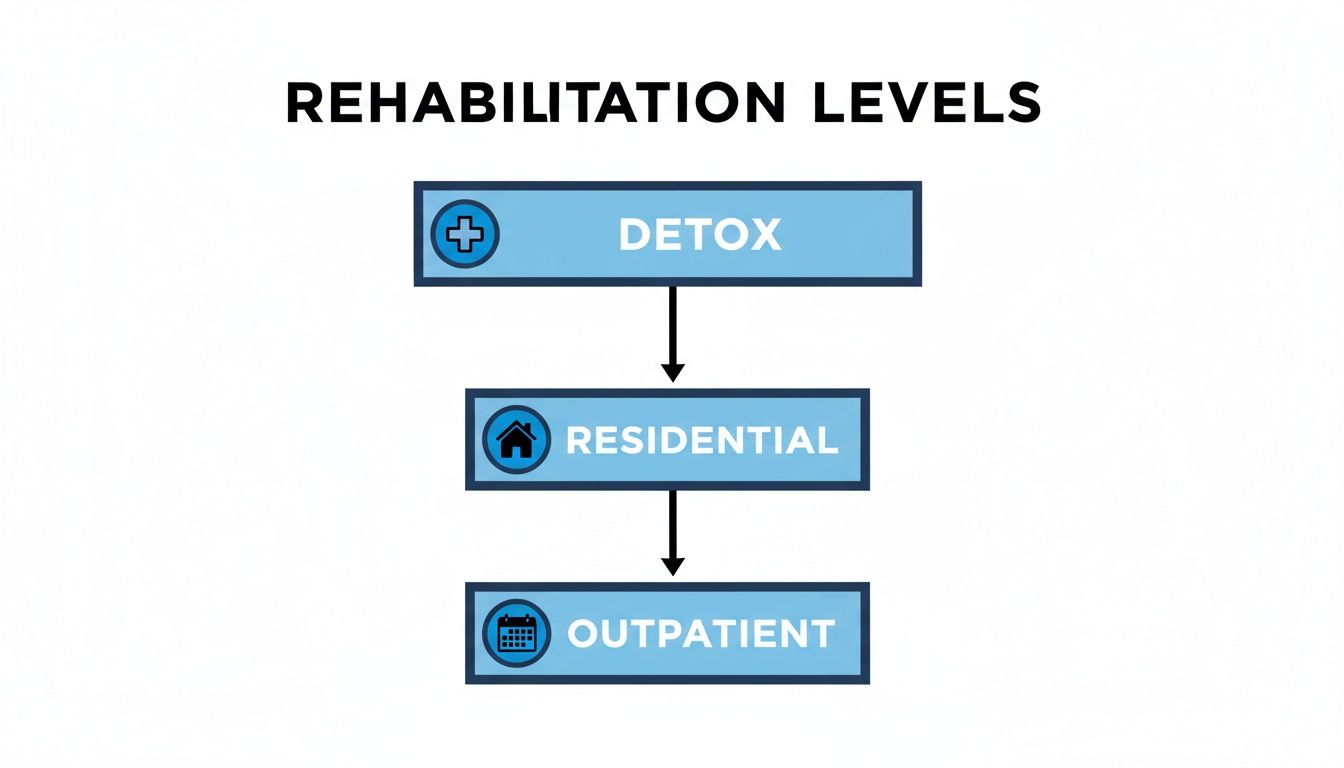
As this shows, the journey typically starts with the 24/7 medical supervision of detox, moves into the supportive structure of residential care, and eventually transitions to the flexibility of outpatient treatment.
Cognitive and Behavioral Therapies
You’ll almost certainly encounter two mainstays of addiction therapy: Cognitive Behavioral Therapy (CBT) and Dialectical Behavior Therapy (DBT). They have distinct, powerful roles in recovery.
Cognitive Behavioral Therapy (CBT) is a goal-oriented therapy that helps you connect the dots between your thoughts, feelings, and actions. The core idea is to identify, challenge, and change the unhelpful thinking patterns that lead to substance use.
Dialectical Behavior Therapy (DBT) is particularly effective for people who struggle with overwhelming emotions. DBT is skill-based, focusing on four key areas: mindfulness, distress tolerance, emotion regulation, and interpersonal effectiveness. It gives you a practical toolbox for managing tough feelings without turning to a substance.
Medication-Assisted Treatment (MAT)
For many people, especially those recovering from opioid or alcohol use disorders, Medication-Assisted Treatment (MAT) is a highly effective option. MAT combines FDA-approved medications with counseling and behavioral therapies, creating a comprehensive, "whole-person" approach.
These medications work scientifically to normalize brain chemistry, block the euphoric effects of substances, and relieve cravings. MAT is a proven medical treatment that can significantly increase a person's chances of sustaining long-term recovery.
Dual Diagnosis: Integrated Treatment
It’s very common for a person with a substance use disorder to also have a co-occurring mental health condition like anxiety, depression, or PTSD. When these two issues exist at the same time, it’s called a dual diagnosis.
The standard of care for this is an integrated approach, where the same team addresses both the substance use and the mental health condition simultaneously. Trying to treat one without the other is often ineffective, as each condition can fuel the other. Quality programs in the Newport Beach area specialize in this type of integrated care. You can learn more about various treatment modalities available locally.
Understanding rehab means grasping its spectrum—from residential treatment to outpatient and support groups. The U.S. has 46.3 million people with substance use disorders, but only a fraction receive care. The approaches used are critical, with Medication-Assisted Treatment (MAT) for opioids being used by 2.3 million Americans in 2023, and therapies like CBT improving access and effectiveness. Learn more about these substance use treatment statistics from the National Institute on Drug Abuse.
A Day in the Life: What to Expect Inside a Program
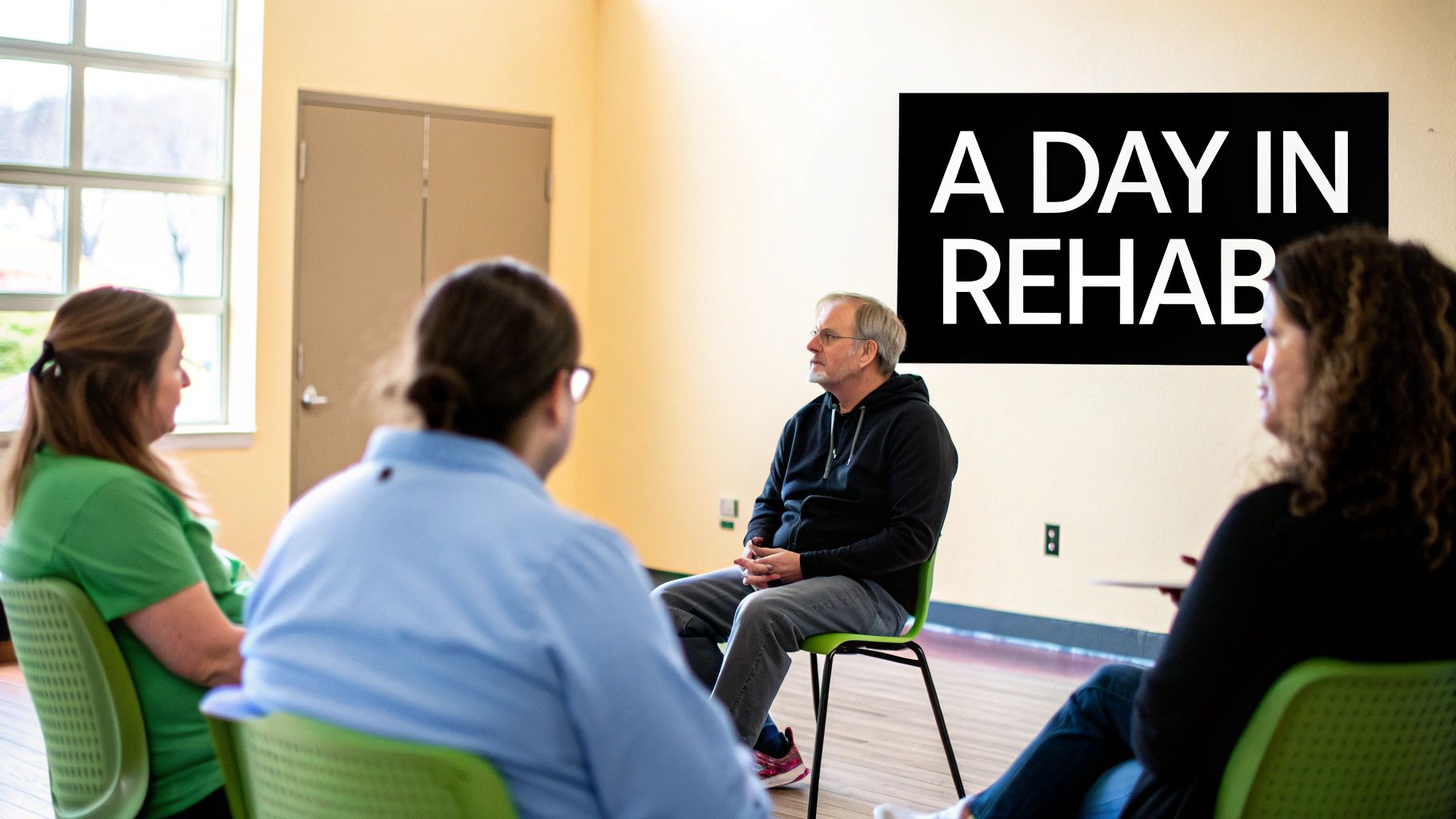
Entering rehab can feel like stepping into the unknown. Not being able to picture the daily routine can feel overwhelming. However, a typical rehab program is built on a foundation of routine, reflection, and learning new skills. The goal is to replace the chaos of a substance use disorder with the predictability of a healthy, supportive schedule.
A typical day starts early. This helps rebuild the healthy habits that are often disrupted by substance use. You’ll usually start with breakfast before gathering for a community meeting or a quiet mindfulness practice, like meditation, to set a positive tone for the day.
The Heart of the Day: Therapy and Learning
The middle of the day is when the core therapeutic work happens. This time is dedicated to sessions that build self-awareness and provide practical tools to support recovery.
Most days will be a blend of different types of therapy:
- Group Therapy: This is a cornerstone of nearly every rehab program. In a safe, confidential space led by a therapist, you'll share your own experiences and hear from others. It can be incredibly helpful to realize you’re not alone.
- Individual Counseling: This is your dedicated, one-on-one time to work with a personal therapist. You can address specific issues, past traumas, or triggers that contribute to substance use.
- Educational Workshops: Recovery is about knowledge as much as willpower. These sessions are like classes that teach essential skills. You might learn about the science behind addiction, how to manage cravings, or ways to communicate better with family.
Afternoon Activities and Evening Wind-Down
Afternoons often focus on balance. You might have more therapy, sometimes combined with activities that heal your mind and body. This could include family therapy sessions, which are vital for repairing relationships and building a strong support system.
Many Newport Beach programs also incorporate holistic therapies like yoga, art therapy, fitness, or guided walks. It’s about rediscovering healthy ways to feel good.
Evenings are usually a quieter time for reflection. After dinner, you might attend a 12-Step meeting (like AA or NA), have some free time for journaling, or join a relaxed group activity. The goal is to wind down in a calm, healthy way, free from triggers, so you can rest for another day of healing.
Practical Examples: Making the Right Choice
Knowing the levels of care is one thing, but applying them to a real-life situation is another. Here are some common scenarios to help you connect the theory to practical next steps.
If someone is shaking, sweating, or nauseous after stopping alcohol: They may need medical detox, not outpatient care. Alcohol withdrawal can be dangerous and requires 24/7 medical supervision. The first step is a clinical assessment at a licensed detox facility in Newport Beach or a nearby area.
If someone can’t stop using despite consequences but is medically stable: Residential or inpatient rehab may be appropriate. This provides a structured, trigger-free environment to focus entirely on recovery without the distractions of daily life.
If someone has a job and family obligations and no severe physical withdrawals: An Intensive Outpatient Program (IOP) in Newport Beach may provide structured care without requiring a full-time admission. This allows them to integrate recovery skills into their daily life in Costa Mesa or Irvine while receiving support.
Questions to Ask a Rehab During an Intake Call
Before committing to a program, it's important to ask the right questions. This helps ensure the facility is a good fit for your specific needs.
- “Are you licensed by the State of California and accredited by an organization like The Joint Commission or CARF?”
- “Do you provide medical detox onsite or refer out?”
- “What does a typical weekly programming schedule look like?”
- “Is dual diagnosis treatment available for co-occurring mental health conditions?”
- “What insurance plans do you accept, and can you help me verify my coverage?”
- “What kind of aftercare support or alumni programs do you offer?”
Finding the Right Rehab Program in Newport Beach
Deciding to seek treatment is a major step, and where you go for help is just as important. For many, choosing a local rehab in Newport Beach or a nearby community like Costa Mesa can make a significant difference in long-term recovery.
Staying close to home makes it easier for family to participate in therapy. It also means you can start connecting with a local recovery community—people you can rely on long after completing the program.
Key Factors in Selecting a Program
Not all treatment centers are created equal. To ensure you receive safe and effective care, look for these quality markers.
Licensing and Accreditation: Verify that the program is licensed by the State of California. Then, look for accreditation from respected national organizations like The Joint Commission or CARF. This is your assurance that the center meets high standards for care and safety.
Evidence-Based Practices: Ask what kind of therapies they use. A quality program will build its treatment around proven methods like Cognitive Behavioral Therapy (CBT), Dialectical Behavior Therapy (DBT), and Medication-Assisted Treatment (MAT) where appropriate.
Qualified Staff: A quality program is staffed by licensed therapists, medical doctors, and certified addiction specialists. Feel free to ask about the credentials of the clinical team.
Verifying Insurance and Costs
Navigating the financial side of treatment can feel complex, but it doesn't have to be. Most insurance plans cover treatment for substance use disorder, but the details vary. Before you commit, it's essential to know what your plan covers.
A reputable treatment center will help you with this. They can run a confidential benefits check to see which levels of care your insurance covers, what your deductible is, and what your out-of-pocket costs might be.
You can take the first step right now and verify your insurance coverage confidentially to see your options.
Frequently Asked Questions About What Is a Rehab
It's normal to have a lot of questions when considering rehab. Here are straightforward answers to some of the most common ones.
How long does rehab take?
There is no set timeline for rehab. The right duration depends on individual needs and progress. However, there are typical timeframes for different levels of care:
- Medical Detox: Usually takes 3 to 10 days.
- Residential Programs: Often last for 30, 60, or 90 days.
- Outpatient Programs: Can continue for several months to provide ongoing support.
What’s the difference between inpatient and outpatient rehab?
The main difference is where you live during treatment. Inpatient rehab (or residential treatment) means you live at the facility 24/7. This creates a supportive environment where you can focus entirely on recovery. Outpatient rehab allows you to live at home and attend treatment sessions during the day or evening, which is suitable if you need to maintain work or family responsibilities in areas like Huntington Beach or Irvine.
Will insurance help pay for rehab?
In most cases, yes. The Affordable Care Act (ACA) and the Mental Health Parity and Addiction Equity Act (MHPAEA) require most major health insurance plans to provide coverage for substance use disorder treatment. However, the amount of coverage varies by plan. It is essential to verify your benefits to understand your specific costs.
What does "dual diagnosis" mean?
Dual diagnosis means a person has both a substance use disorder and a co-occurring mental health condition, such as depression, anxiety, or PTSD. Effective treatment addresses both conditions simultaneously with an integrated care plan, as they often influence one another.
Could I get fired for going to rehab?
Federal laws like the Family and Medical Leave Act (FMLA) and the Americans with Disabilities Act (ADA) offer job protection for individuals seeking medical treatment for a substance use disorder. FMLA may allow for up to 12 weeks of unpaid, job-protected leave. It is advisable to speak with your human resources department to understand your company's specific policies.
Finding your way to recovery starts with clear, reliable information. At Newport Beach Rehab, we provide a compassionate, neutral resource to help you understand your options and find the support that is right for you.
Compare detox and rehab options in Newport Beach.
Sources
- Fortune Business Insights. (2024). Addiction Treatment Market Size, Share, Growth… Retrieved from https://www.fortunebusinessinsights.com/addiction-treatment-market-102214
- Coherent Market Insights. (2024). Drug Addiction Treatment Market Report… Retrieved from https://www.biospace.com/press-releases/drug-addiction-treatment-market-size-to-surpass-usd-31-20-billion-globally-by-2032-at-7-4-cagr-coherent-market-insights
- National Institute on Drug Abuse (NIDA). (2024). IC Fact Sheet FY 2025. Retrieved from https://nida.nih.gov/about-nida/legislative-activities/budget-information/fiscal-year-2025-budget-information-congressional-justification-national-institute-drug-abuse/ic-fact-sheet-2025
- Substance Abuse and Mental Health Services Administration (SAMHSA). (2023). Key Substance Use and Mental Health Indicators in the United States. Retrieved from SAMHSA's National Survey on Drug Use and Health.